
Start Reading
In this edition
Wiktor Szydarowski, ESPON EGTC Director
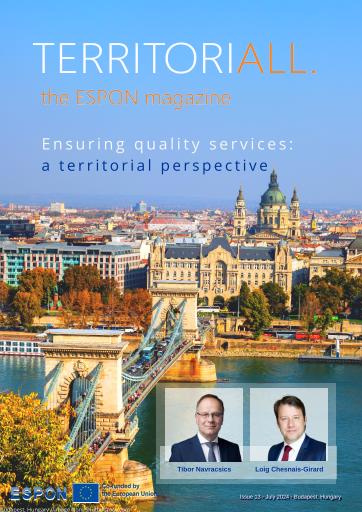
Tibor Navracsics, Minister for Public Administration and Regional Development, Hungary
The revision of the Territorial Agenda 2030 and the regions lagging behind
Cross-border cooperation improves public services in lagging regions
Pavel Branda Around one-third of EU citizens live
Loïg Chesnais-Girard, President of the Brittany Region, President of CPMR
Access to essential services in the EU: key challenges for the most vulnerable
Gilberto Pelosi, Policy Officer, European Commission
Europe’s rural-urban divide and the crisis of recognition
Massimiliano Mascherini, Eurofound
The Role of Public Services in the New Model of Hungarian Territorial Policy
Zsuzsanna Farkas, Kristóf Orbán, Ministry of Public Administration and Regional Development, Hungary
Boosting accessibility to services of general interest in European regions
Nicolas Rossignol, ESPON EGTCAssistant Director, Research and Policy
Strategies for services in shrinking places
Alison Weingarden, Centre for Entrepreneurship, SMEs, Regions and Cities, OECD.
Rural regions are proactive regions: learnings from a Territorial Agenda Pilot Action
Bridging the skill gap in public service digitalisation in Latvia
Anita Livija Rozenvalde Ministry of Environmental Protection and Regional Development of Latvia
Village caretaker service as a macro-regional best practice
Gyöngyi Schwarcz, senior researcher Research Institute for National Strategy
Co-working in rural areas – a new land of possibilities?
Chiara Litardi, Martina Bisello, Eurofound
Importance of cross-border service provision along the borders of Hungary
Roland Hesz, Central European Service for Cross-Border Initiatives (CESCI)
Opportunities and good examples of grassroots initiatives in public service delivery
Changing the narrative: accepting shrinking for innovative planning in rural areas
Ulla Higdem and Windy Kester Moe, Inland Norway University of Applied Sciences
Investigating roles beyond size: small towns in the European Alps
Dominik Bertram & Pr. Dr. Tobias Chilla, University of Erlangen-Nuremberg, Erlangen, Germany